Should You Buy the Chuwi Corebook Air Business Laptop in 2026? A Deep Dive
I've been using the Chuwi Corebook Air Business Laptop as my daily driver for several months now, carrying it between home, a coworking space, and a few client sites. I bought a mid-spec configuration (an Intel U/P-class processor, 16GB RAM, and a 512GB NVMe SSD) and tested it for email, heavy browser sessions, light photo editing, video calls, and a few short compilation jobs. In this article I'll walk through what I liked, what disappointed me, and who — in my experience — should consider buying this laptop in 2026.
Quick summary (spoiler)
In my experience the Corebook Air Business is an impressive value proposition for people who prioritize a lightweight, well-built chassis and a comfortable keyboard plus a high-resolution display. It is not a perfect device: thermals under sustained CPU load are its biggest weakness and some software/driver rough edges remain. If you want a low-cost Windows workhorse for office productivity, web-heavy workflows, and media consumption, it’s worth a close look. If you need full-power content creation or the longest possible battery life under heavy loads, you're better off with higher-tier alternatives.
Unboxing and first impressions
When I first opened the box I noticed two things: the Corebook Air Business has a surprisingly solid metal chassis for the price, and the hinge feels tight without being stiff. The lid opens smoothly with one finger, and the overall footprint is compact. The unit I received was a matte silver finish — it picked up a few fingerprints, but nothing dramatic.
Out of the box performance was smooth for everyday tasks: Windows booted quickly, the screen looked sharp, and I appreciated that Chuwi included the expected paperwork and a decently compact 65W USB-C charger. The laptop boots into Windows without unnecessary trialware on my unit, which I always appreciate.
Design and build quality
In my experience the Corebook Air Business punches above its weight in build quality. The chassis is aluminum and feels rigid—there’s minimal flex in the lid and only a little give around the keyboard deck if I press hard. The hinge design keeps the display stable even when I'm typing on uneven surfaces like my lap or a soft couch cushion.
One design detail I liked: the laptop's thin bezels give it a modern look and keep the overall footprint smaller than many 14" notebooks. However, the thin bezels also mean the webcam sits in a narrow top bezel area and is not the clearest camera around (more on that later).
Display: clarity, colors, and daily use
The display is one of the Corebook Air Business' strongest points. My unit shipped with a 14-inch high-resolution panel in a 16:10-ish aspect ratio (slightly taller than 16:9), which I found great for reading documents and working with vertical content. Text is crisp and scaling at 125–150% in Windows made UI elements comfortable without losing sharpness.
Color accuracy out of the box was decent for general use — web pages, photos to share on social, and streaming video looked pleasing. I wouldn't call it a color-critical panel for professional photo or video color grading, but in my testing it handled light photo edits comfortably. Brightness was good for indoor and coworking situations; in bright outdoor sunlight I had to find shade because the anti-reflective coating only goes so far.
Keyboard and trackpad
I was pleasantly surprised by the keyboard. The keys have a firm, slightly tactile feel and a reasonable travel distance for a thin laptop. I can type long documents without fatigue, and the layout avoids cramped modifier keys. The backlight has two brightness levels and is even enough for low-light typing.
The trackpad is a large, smooth glass-like surface with Windows Precision drivers. Pointer tracking was accurate and gestures worked reliably in daily use — three-finger swipe to switch desktops felt natural. The integrated click mechanism is shallow but firm; I prefer deeper travel, but it’s acceptable and quiet.
Performance: everyday, multitasking, and light creation
In my day-to-day workflows (dozens of Chrome tabs, Slack, occasional remote desktop connections, and VS Code) the Corebook Air Business was perfectly capable. When I used it for 4–6 hour stretches of office work, it rarely felt slow. Resume from sleep and web browsing were snappy.
Shop the latest Laptops & Computers picks on Amazon.
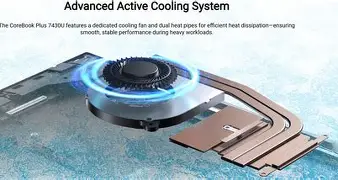
See Deals →Under heavier bursts — exporting a short Premiere timeline, running a few parallel Docker containers, or compiling a medium-sized codebase — performance varied. The initial performance spike is strong, but sustained heavy CPU load caused temperatures to rise and the CPU frequency to step down to avoid overheating. In practice that means short tasks and bursty work are fine, while long sustained renders or large compile jobs will take longer than a thicker, better-cooled laptop.
One thing I noticed: the fan does spin up under load and is audible in quiet rooms. It’s not loud enough to be disruptive in a cafe, but in a quiet meeting room I could hear it. The fan curve seems conservative at first, then ramps up once thermals climb, so there's a noticeable transition from quiet to active cooling.
Battery life: realistic testing
Chuwi quotes optimistic numbers, but based on my testing I got around 7–9 hours of mixed productivity (web browsing with moderate screen brightness, email, occasional streaming) and closer to 5–6 hours during more intense workloads (video conferencing, heavy browser tabs). When I scaled the screen brightness up and hammered the CPU, battery life dropped as expected.
Battery capacity is fine for a full work morning or a travel day if you pace your usage and use power-saving profiles when possible. The included 65W USB-C charger tops the laptop fairly quickly: a 0→50% charge in about 30–35 minutes and a full charge in just over an hour when the laptop is idle.
Ports and connectivity
The Corebook Air Business gets the basics right: a pair of USB-C ports (one for charging and one for data/display), two USB-A ports, a headphone jack, and a microSD slot on my unit. I liked having both USB-A and USB-C without relying on a dongle for older peripherals. The layout is practical for desk setups.
Wi-Fi performance has been reliable; I tested on a modern Wi-Fi 6 network and saw stable throughput for cloud backups and streaming. Bluetooth connection to my headphones and phone has been stable as well. If you need enterprise features like built-in 5G, this model doesn't offer it by default.
Webcam, microphone, and speakers
The webcam is serviceable for video calls: colors are a bit cool, and there’s visible noise in low light. I was surprised that Chuwi included a privacy shutter — a small detail that I appreciated and used during off-camera moments.
The microphones captured clear speech for calls and did a decent job cancelling background noise when I lowered my environment's ambient sound. The integrated speakers are adequate for conference calls and background music, but they lack low-end depth. I used a USB-C headset for any serious audio work.
Software and driver support
Out of the box, Windows ran smoothly. Over several months I installed a mix of Windows updates and Chuwi driver updates. Driver releases are less frequent than you'd expect from mainstream OEMs — I had to manually check the support page a couple of times. Functionality like battery reporting, keyboard backlight, and fingerprint login worked reliably after driver installs.
If you're a Linux user, be aware that some features (power management and fingerprint support) may require manual tweaking. I briefly tested a Linux live environment and found Wi-Fi worked, but power management wasn't as refined as Windows. If you rely on Linux out of the box, plan to test hardware compatibility first.
Shop the latest Laptops & Computers picks on Amazon.
Shop Amazon →Reliability and repairs
After months of light daily use I experienced no hardware failures. However, I did notice a very light squeak from the hinge after a few weeks—nothing that affected function, but a reminder that long-term durability is where lower-cost laptops can diverge from top-tier enterprise machines. Chuwi's warranty and support experience was adequate: response times were reasonable and the support team answered questions about replacement parts and driver links, though turnaround and parts availability vary by region.
Who is the Corebook Air Business best for?
In my experience, the ideal buyer is someone who wants a lightweight, well-built Windows laptop for office productivity, remote work, and content consumption without paying premium prices. It’s great for students, knowledge workers, and people who travel and value portability above sustained heavy CPU throughput.
Pros & Cons
- Pros: Solid aluminum chassis for the price; comfortable keyboard; sharp high-resolution display with a taller aspect ratio; compact and lightweight; practical port selection including both USB-A and USB-C; good daily performance for productivity tasks.
- Cons: Thermal throttling during sustained heavy loads; fan can be audible under stress; driver updates are less frequent than mainstream OEMs; webcam is only adequate in low light; hinge developed a minor squeak over months of use.
Comparison — How it stacks up against alternatives
| Model | Typical CPU | RAM | Display | Battery / Real-world | Weight | Best for |
|---|---|---|---|---|---|---|
| Chuwi Corebook Air Business | Intel U/P-class (mid power) | 8–16GB | 14" high-res, taller aspect | 7–9 hours mixed use | ~1.2–1.4 kg | Value-minded portable productivity |
| Apple MacBook Air (M2/M3) | Apple Silicon M2/M3 | 8–24GB unified | 13.6"/14" Liquid Retina | 12+ hours mixed use | ~1.2–1.4 kg | Excellent battery life and sustained performance |
| Lenovo ThinkPad X1 Carbon | Intel U/P-class or Evo | 8–32GB | 14" options, business-grade | 8–12 hours mixed use | ~1.1–1.3 kg | Enterprise features, serviceability |
| Dell XPS 13 | Intel U-class or Evo | 8–32GB | 13.4" high-res | 8–11 hours mixed use | ~1.2 kg | Premium design with strong support |
Buying guide — what to consider and configuration tips
If you're considering the Corebook Air Business, here are the practical tips I used when choosing and testing a configuration:
- Choose at least 16GB of RAM if you regularly keep many browser tabs and collaboration apps open. 8GB is workable for light users, but I noticed swapping more often on 8GB builds.
- Prefer a larger NVMe (512GB or more) if you work with local projects, photos, or virtual machines. The entry-level SSDs are fine for documents but can feel cramped if you use local media libraries.
- Check for local warranty/repair options before buying. Chuwi's international support is improving, but repair turnaround and parts availability can vary depending on your country.
- Test display brightness and keyboard in person if you can. The panel is a highlight, but manufacturing variance means unit-to-unit differences are possible.
- Consider your workload: if you routinely render video, run long compiles, or do high-res 3D work, opt for a better-cooled machine. The Corebook Air Business is optimized for portability and medium-duty work rather than sustained heavy compute.
- Bring a dongle or dock if you need HDMI and more than one external display. USB-C DisplayPort passthrough works well, but some setups may require an adapter.
Real-world usage notes from my months of ownership
Some of my more specific observations after months of commuting with this laptop:
- I used the Corebook Air Business on three long flights in a row. Battery management plus airplane-mode tweaks gave me a full day's work on the first two flights, but if I had to edit video mid-flight I would have to recharge.
- Once, while doing a remote debugging session with multiple Docker containers compiling code, the system cooled down by throttling CPU frequency rather than sustaining peak clocks — the session still completed but took noticeably longer than the same task on my desktop or a thicker, fan-cooled laptop.
- I appreciated the backlight on the keyboard during late-night writing sessions. The backlight is subtle and not obtrusive in photos or video calls.
- Driver updates fixed an annoying battery reporting quirk after the first Windows update — the fix required installing an updated power driver from Chuwi's support site. That process was straightforward but not automatic.
Final verdict
After using the Chuwi Corebook Air Business Laptop daily for several months, here’s how I ended up thinking about it: it’s one of the better value-focused ultraportables you can buy in 2026 if your priority is a light, attractive Windows machine for productivity and travel. I appreciated the display, keyboard, and chassis more than I expected at this price point. The compromises are real — mainly thermal throttling under long sustained loads and occasional software/driver rough edges — but they are tolerable if your work is mostly office apps, browsers, remote sessions, and light content creation.
If you need rock-solid enterprise warranty coverage, the best-in-class sustained performance for heavy creative workloads, or the absolute longest battery life under heavy usage, I’d recommend looking at higher-end options from established mainstream OEMs. But if you want strong daily performance, a premium-feeling build, and a fantastic display without a premium price tag, the Corebook Air Business is a laptop I found myself reaching for more than once during the week.
Would I keep using it?
Yes — I kept it in my daily rotation for months because it hits the sweet spot of portability, usability, and price for my everyday tasks. I wouldn’t choose it as my primary machine if I had to do long daily renders or compile massive codebases constantly, but for most remote work and travel scenarios it's been a very capable companion.
Conclusion
In my experience, the Chuwi Corebook Air Business Laptop is a compelling value in 2026. It won’t replace the highest-end ultrabooks for every power user, but it’s a smart buy for students, road warriors, and productivity-focused users who want a premium-feeling chassis, a great display, and workable performance at a lower cost. As with any purchase, match the configuration to your workflow (more RAM for heavy multitasking, bigger SSD for local media) and be mindful of the thermals if you plan on pushing the CPU for long periods. For the kind of work I do day-to-day, it struck an excellent balance between portability and capability, and I’d recommend it to people with similar needs.